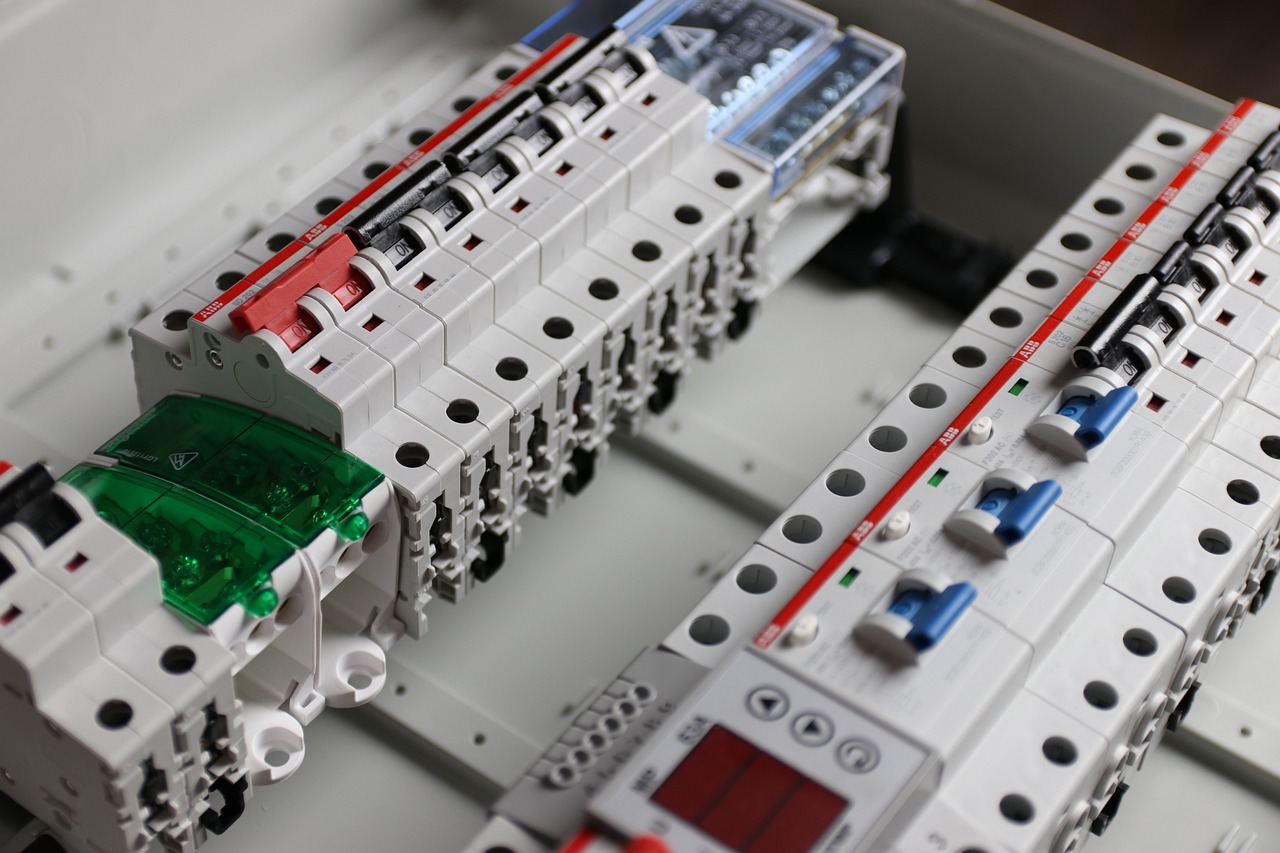
ESU buys and sells new & used Commercial Circuit Breakers in San Diego.Electrical Supplies Unlimited (ESU) is your trusted source for high-quality commercial circuit breakers, serving businesses and contractors in need of reliable electrical components. While residential breakers are designed for lower voltage applications, such as homes and small buildings, commercial circuit breakers are built for higher capacity electrical systems, typically found in large offices, industrial buildings, and retail spaces. These breakers provide enhanced durability, greater fault protection, and the ability to handle higher electrical loads. At ESU, we carry a wide selection of commercial circuit breakers to meet the needs of your project, ensuring safety and compliance with electrical codes.
Commercial circuit breakers can be challenging to work with, especially when installations require specific supporting hardware. These breakers are typically mounted on panel boards or inside switchgear cabinets, and because equipment designs evolve over time, locating compatible hardware can be tricky. To ensure you get the best match for your system, Electrical Supplies Unlimited recommends bringing photos and measurements of your installed breakers before visiting our San Diego store. With over 40 years of experience in the electrical supply industry, ESU is your trusted partner for commercial circuit breakers in San Diego—offering expert advice, accurate product matching, and outstanding customer service.
Unlike residential circuit breakers that protect homes, commercial circuit breakers are engineered to handle higher voltages and more demanding electrical loads in environments such as office buildings, warehouses, and industrial facilities. These breakers are designed for three-phase systems and provide reliable protection for large-scale applications. At Electrical Supplies Unlimited in San Diego, we stock a wide selection of commercial circuit breakers to suit any requirement. Backed by decades of industry expertise, our team is ready to help you find the right solution at a competitive price. Visit ESU today for the best in commercial circuit breakers and electrical supplies in San Diego.

Electrical Supplies Unlimited (ESU) provides a comprehensive selection of high-quality circuit breakers for residential, commercial, and industrial applications. Residential breakers are commonly used in home electrical panels to protect circuits from overloads and short circuits. These breakers automatically cut off power when a fault is detected, preventing fires and equipment damage. Commercial breakers operate on the same principle but are built to handle higher voltages and more demanding electrical loads typically found in offices, retail buildings, and industrial facilities. ESU also offers popout resettable breakers, which feature a convenient button that "pops out" when tripped, allowing for easy manual reset without replacement—ideal for repeated-use circuits and safety-critical systems.
In addition to traditional circuit protection, ESU stocks specialized components such as DIN rail mounted breakers, which are widely used in industrial and automation control panels. These compact units snap into standardized DIN rails, making installation simple and scalable for complex systems. Popout resettable breakers are also available in DIN-mounted form for streamlined panel integration. To further enhance safety and functionality, ESU provides a variety of breaker accessories, including lockout devices, mounting hardware, and labels, enabling users to customize and secure their breaker setups according to specific code requirements or operational needs. Whether you're outfitting a residential panel or an industrial control cabinet, ESU has the right circuit protection solution.Circuit breakers are electrical switches designed to protect an electrical circuit from damage caused by overload or short circuit.
If a circumstance arises where a fault condition occurs, the switch discontinues electrical flow. This circuit breaker can be reset either manually or automatically. In contrast, a fuse must be replaced when it operates one time.
Circuit breakers are made in varying sizes, from small devices that protect an individual household appliance up to large switchgear
designed to protect high voltage circuits feeding an entire city.
Types of Circuit Breakers
Low voltage circuit breakers
Medium-voltage circuit breakers
High-voltage circuit breakers
Magnetic circuit breakers
Thermal magnetic circuit breakers
Common trip breakers
Electrical Supplies Unlimited buys and sells a wide range of new, used, surplus, obsolete, and hard-to-find circuit breakers. Examples of featured circuit breakers available through ESU include the Cutler Hammer 100 Amp Circuit Breaker, Square D QO 20 Amp Circuit Breaker, and Siemens Q120 20 Amp Circuit Breaker. These products represent just a portion of the electrical equipment ESU can source for electricians, electrical contractors, commercial facilities, industrial customers, and businesses throughout the United States.
ESU also buys and sells specialty and replacement circuit breakers from manufacturers including GE, Federal Pacific, and Zinsco. Featured products include the GE THQL 20 Amp Circuit Breaker, Federal Pacific 20 Amp Circuit Breaker, and Zinsco 20 Amp Replacement Circuit Breaker. Whether you need a commonly available breaker, an obsolete replacement, or a hard-to-find circuit breaker for an existing electrical panel, Electrical Supplies Unlimited can help locate the right equipment and can also purchase surplus circuit breakers and other electrical equipment from businesses and contractors.
Operation
All circuit breakers have common features in their operation, although details vary substantially depending on the voltage class, current rating and type of the circuit breaker.
The circuit breaker must detect a fault condition; in low-voltage circuit breakers this is usually done within the breaker enclosure. Circuit breakers for large currents or high voltages are usually arranged with pilot devices to sense a fault current and to operate the trip opening mechanism. The trip solenoid that releases the latch is usually energized by a separate battery, although some high-voltage circuit breakers are self-contained with current transformers, protection relays, and an internal control power source.
Choosing the right circuit breaker brand is essential for protecting your home, office, or industrial facility from electrical overloads and short circuits. With many brands available, it’s important to understand the differences in reliability, performance, and compatibility before making a purchase.
In this guide, we compare the best circuit breaker brands for residential, commercial, and industrial applications, helping you make an informed decision for your electrical system.
Square D, a brand of Schneider Electric, is one of the most recognized and widely used breaker brands in North America. Known for reliability and performance, Square D offers:
Square D breakers are widely available and offer strong compatibility with many panel types, making them a popular choice for electricians and homeowners alike.
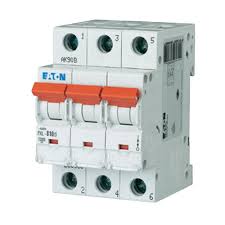
2. EatonEaton is a leading manufacturer of circuit protection products for residential, commercial, and industrial use. Popular Eaton product lines include:
Eaton breakers are praised for durability, long-term reliability, and compatibility with legacy panels.
Siemens circuit breakers are known for their quality and affordability. Their residential and commercial breakers include:
Siemens breakers are widely used in new installations and are recognized for their easy installation and long-term performance.
GE has been a trusted name in residential electrical systems for decades. Their breaker offerings include:
Challenger breakers were popular in older residential and commercial installations but are less commonly used in new construction today. Some models have been recalled due to reliability concerns, so replacement with modern breakers is recommended when upgrading older panels.
When selecting a breaker brand, consider:
To explore more guides on breaker selection, troubleshooting, and safety, visit our Circuit Breaker Resource Hub. Our resources help homeowners, electricians, and contractors make informed decisions when installing or replacing breakers.
For a complete overview of breaker types, brands, and electrical safety considerations, visit our Circuit Breaker Resource Hub where we provide expert guides for residential, commercial, and industrial electrical systems.
For a complete overview of breaker types, brands, and electrical applications, visit our Circuit Breaker Resource Hub.
The simplest circuit protection device is the fuse. A fuse is just a thin wire, enclosed in a casing, that plugs into the circuit. When a circuit is closed, all charge flows through the fuse wire -- the fuse experiences the same current as any other point along the circuit. The fuse is designed to disintegrate when it heats up above a certain level -- if the current climbs too high, it burns up the wire. Destroying the fuse opens the circuit before the excess current can damage the building wiring.
The problem with fuses is they only work once. Every time you blow a fuse, you have to replace it with a new one. A circuit breaker does the same thing as a fuse -- it opens a circuit as soon as current climbs to unsafe levels -- but you can use it over and over again.
The basic circuit breaker consists of a simple switch, connected to either a bimetallic strip or an electromagnet. The diagram below shows a typical electromagnet design.
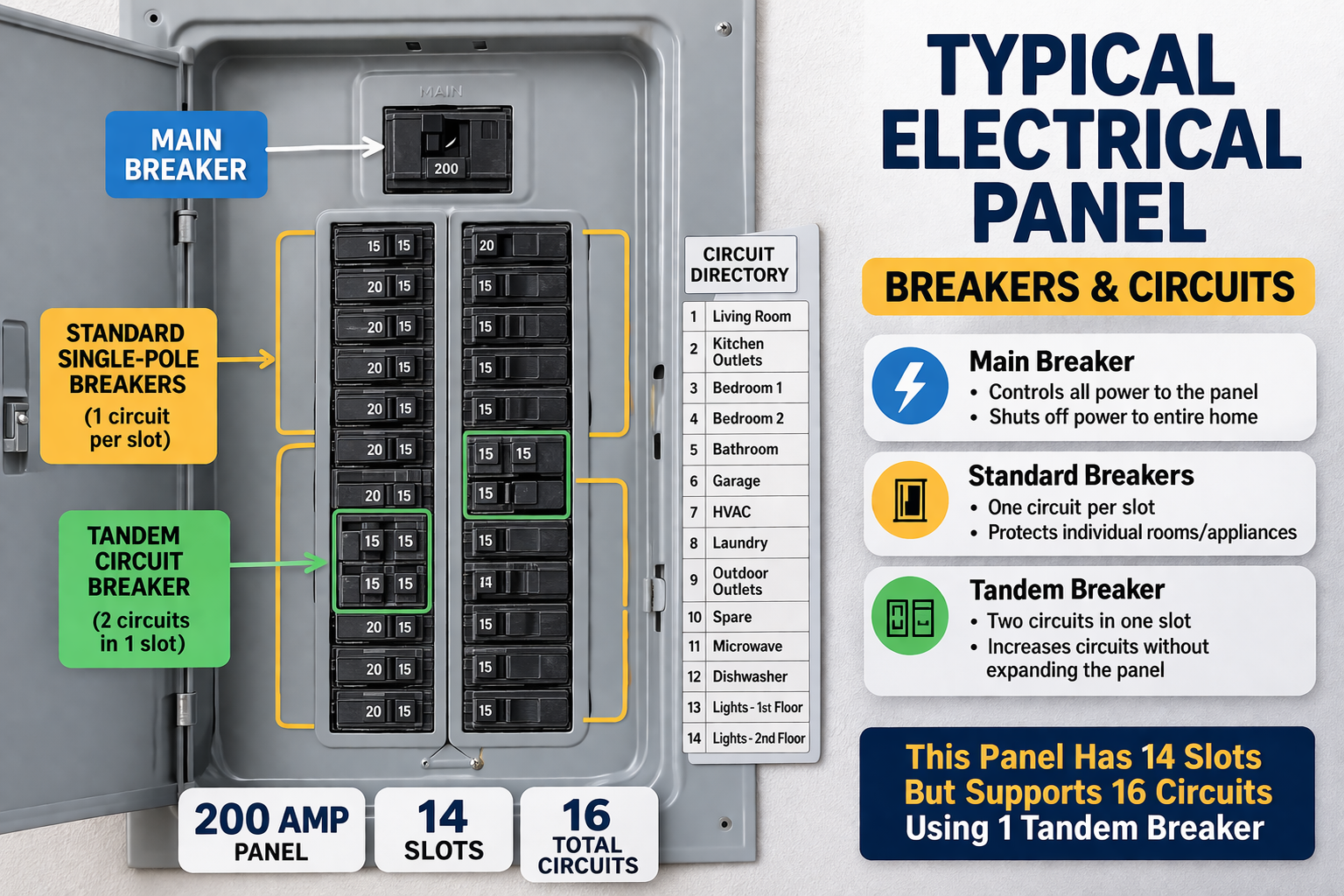
One of the most common questions homeowners and contractors ask is how many breakers can be in a panel. The answer depends on the panel’s design, electrical capacity, and manufacturer specifications—not just the physical number of breaker slots.
Understanding breaker limits is important for maintaining a safe electrical system and avoiding overloaded panels or code violations.
Breaker Limits Are Based on Panel RatingEvery electrical panel is designed with a maximum number of circuits it can safely support. This limit is determined by the panel manufacturer and is clearly listed on the panel label.
For example, a panel may be rated for 20, 30, or 40 circuits depending on its size and configuration. Even if additional breakers physically fit, exceeding the rated number of circuits can create safety risks.
It’s important to understand the difference between breaker slots and circuits:
Some panels allow more circuits than slots by using tandem circuit breakers, which fit two circuits into a single slot.
Tandem breakers can increase the number of circuits in a panel without expanding its size. However, they are only allowed in panels that are specifically designed to accept them.
Installing tandem breakers in the wrong panel or exceeding the allowed number of circuits can lead to overheating, code violations, and potential electrical hazards.
Learn more about how these work in our guide to tandem circuit breakers.
While exact limits vary by manufacturer, here are common examples:
Always refer to the panel label to confirm the exact circuit limit for your system.
Adding too many breakers beyond the panel’s rating can result in:
If your panel is already at capacity, adding more circuits without upgrading the panel is not recommended.
If you need more circuits than your panel allows, it may be time for an upgrade. This is especially common during:
Upgrading your panel provides more capacity and improves overall electrical safety.
Learn more about costs in our guide to circuit breaker panel upgrade cost.
Using the correct breaker type and brand is essential for maintaining safe operation. Breakers must be compatible with your panel and rated for the correct electrical load.
For more guidance, visit our How to Choose the Right Circuit Breaker guide.
To learn more about breaker types, troubleshooting, and electrical safety, visit our Circuit Breaker Resource Hub.